Understanding Emissivity
The single most misunderstood factor in infrared temperature measurement — and the most common cause of inaccurate readings.
What Is Emissivity?
Emissivity (ε) is a dimensionless value between 0 and 1 that describes how efficiently a surface emits infrared radiation compared to a theoretical perfect emitter (a "blackbody" with ε = 1.0). A surface with high emissivity emits most of the infrared energy corresponding to its temperature. A surface with low emissivity reflects much of the surrounding infrared energy instead of emitting its own.
Infrared thermometers calculate temperature based on the infrared energy they detect. If the emissivity setting in the thermometer does not match the actual emissivity of the surface being measured, the calculation will be wrong — even if the thermometer itself is perfectly calibrated.
⚠ Key Principle: Emissivity charts provide guidance — not calibration. Emissivity changes with surface finish, oxidation, dirt, oil, paint, and temperature. Two "identical" metal surfaces can read very differently depending on their condition.
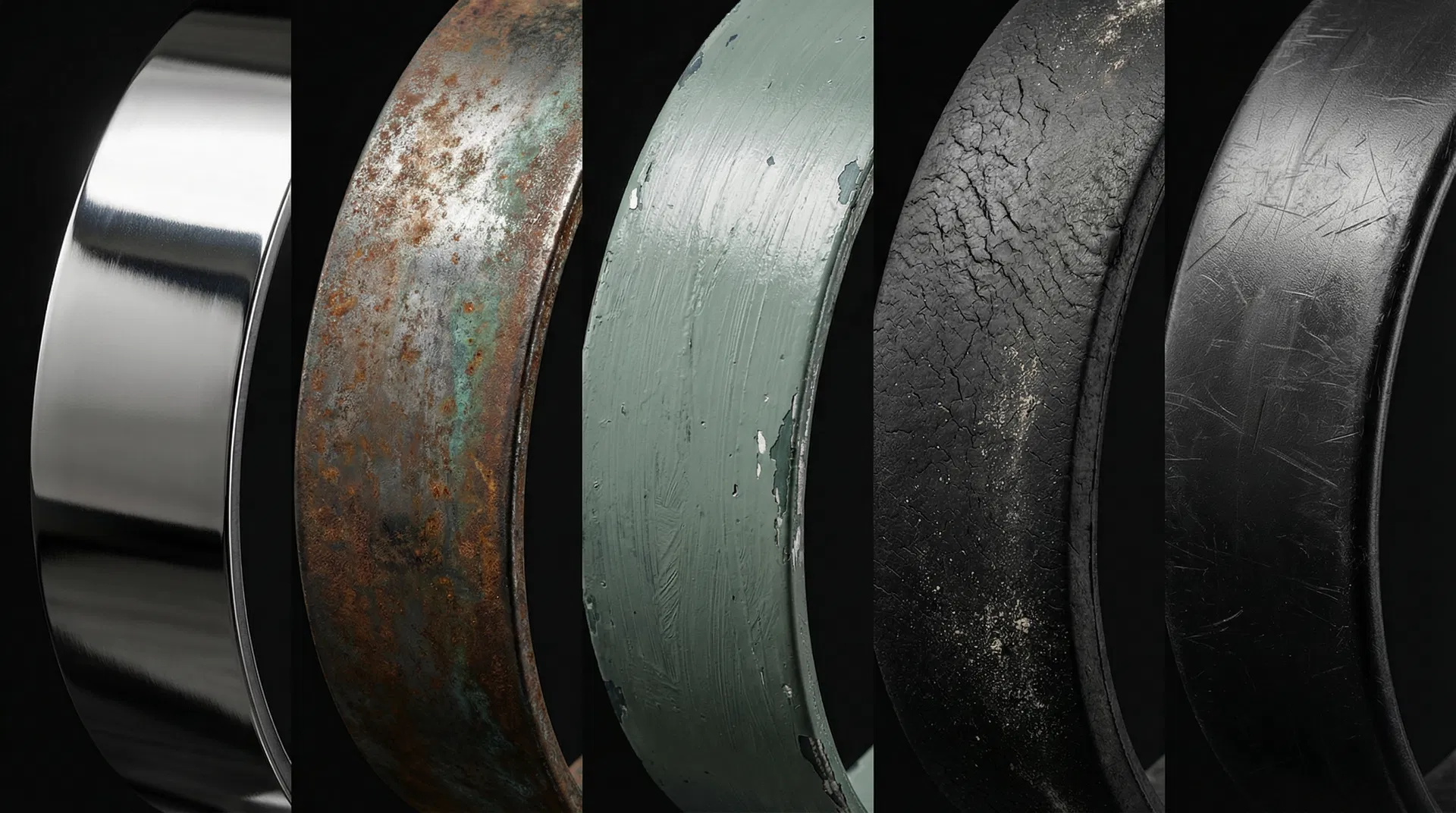
Surface condition — polished vs. oxidized vs. coated — dramatically affects emissivity and IR measurement accuracy.
Emissivity Reference Chart
Values are approximate. Surface condition, oxidation, and coating significantly affect actual emissivity.
| Material / Surface | Emissivity (ε) |
|---|---|
| Human Skin | 0.98 |
| Ice | 0.97 |
| Water | 0.96 |
| Matte Black Paint | 0.95 |
| Rubber | 0.95 |
| Plastic (most) | 0.90–0.95 |
| Flat White Paint | 0.90 |
| Paper / Cardboard | 0.90 |
| Concrete | 0.90 |
| Brick | 0.93 |
| Glass | 0.85–0.95 |
| Wood | 0.85–0.95 |
| Oxidized Steel | 0.70–0.85 |
| Cast Iron (oxidized) | 0.80 |
| Copper (oxidized) | 0.60–0.80 |
| Stainless Steel (oxidized) | 0.40–0.60 |
| Aluminum (oxidized) | 0.20–0.40 |
| Stainless Steel (polished) | 0.10–0.30 |
| Copper (polished) | 0.05–0.10 |
| Aluminum (polished) | 0.05–0.10 |
Practical Guidance by Emissivity Level
High Emissivity (ε ≥ 0.90) — Easiest to Measure
Plastics, painted surfaces, rubber, organic materials, skin, paper, concrete, and most non-metallic surfaces fall in this range. A standard fixed-emissivity IR thermometer set to 0.95 will produce accurate results. This covers the majority of everyday industrial, food service, and HVAC applications.
Medium Emissivity (ε 0.40–0.85) — Requires Attention
Oxidized metals, cast iron, and some ceramics fall here. An adjustable-emissivity IR thermometer is recommended. Set the emissivity to the appropriate value for the material and condition. Readings will be accurate if the correct value is used, but errors increase as emissivity decreases.
Low Emissivity (ε < 0.40) — High Risk of Error
Polished metals, stainless steel, aluminum, and copper in this range reflect significant amounts of ambient infrared energy. Readings can be dramatically wrong if emissivity is not correctly set. Three options exist:
- 1. Use an adjustable-emissivity IR thermometer set to the correct value
- 2. Apply matte black electrical tape (ε ≈ 0.95) to the surface, allow thermal equilibrium, then measure the tape
- 3. Use a contact probe thermometer for verification
Field Best Practice: The Tape Method
For shiny or reflective surfaces, apply a small piece of matte black electrical tape (ε ≈ 0.95) to the surface. Allow it to reach thermal equilibrium with the surface (typically 1–2 minutes). Then measure the tape — not the metal. This single technique solves the majority of infrared misuse in the field and requires no adjustable-emissivity thermometer.
View infrared thermometers with adjustable emissivity at TIPTEMP.com
Compare adjustable-emissivity IR thermometers at TIPTEMP ↗